14 November, 2026
06:00 PM - 07:00 PM
Aditya Birla Auditorium | On-site
Public art has become one of the most visible, and most contested, forms of contemporary practice in Indian cities. Murals transform neglected walls into landmarks, foundations fund large-scale interventions in stepwells and heritage sites, and artists work at civic and even high-altitude scale rather than within gallery walls. But beneath the celebratory framing lie harder questions: who commissions this work, who it is really for, and who sustains it once the launch is over.
This panel brings two distinct perspectives into conversation. Ranjit Hoskote, curator of SITE Jodhpur's inaugural edition, brings a critical lens shaped by decades of curating cultural memory for public view. Vishal Dar, curator of the sā Ladakh Biennale, brings the reckoning of siting art at 3,000 metres, where landscape itself becomes collaborator.
Moderated by Veerangana Solanki, the conversation asks what it takes for public art to outlast its funding cycle and its moment of visibility.
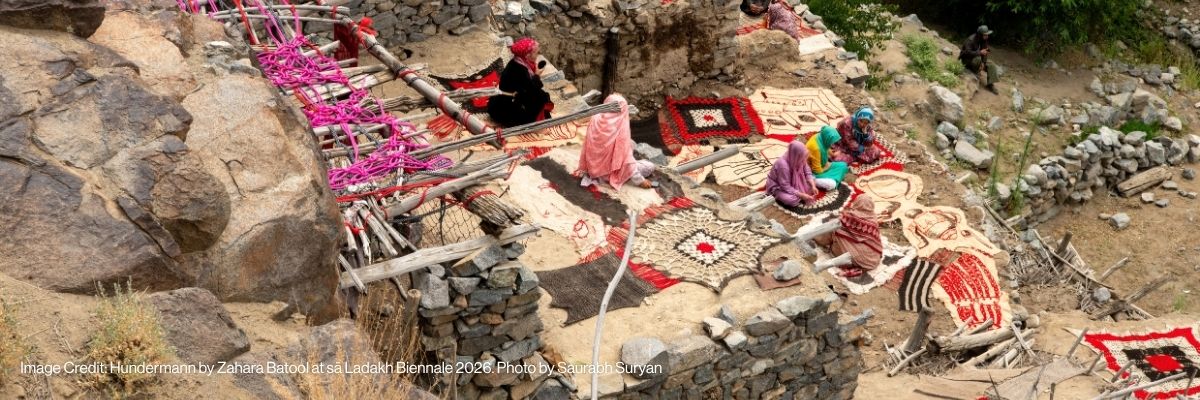
Image Credit: Hundermann by Zahara Batool at sā Ladakh Biennale 2026. Photo by Saurabh Suryan
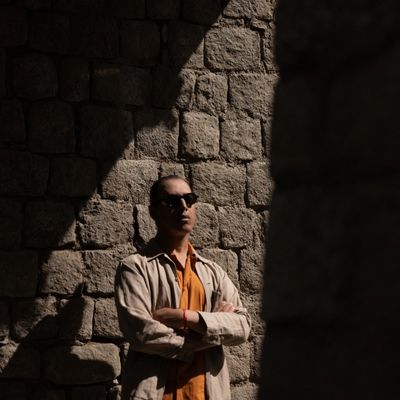
Vishal K. Dar is an artist/architect whose work displays an artful approach to the use of modern technology that explores through print/installation/sculpture/video the potential of their material. Dar erases traditional definitions of art, performance and architecture. Rather than portraying figurative objects, his work focuses primarily on the place-making, which emanate from the inherent characteristics of the material, site and context. Dar was the curator of the recently concluded sa biennale, 2026 in Ladakh, India.
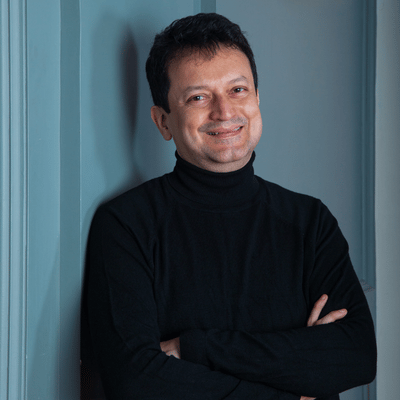
Ranjit Hoskote is a poet, translator, cultural theorist and curator. His poetry collections include Vanishing Acts: New & Selected Poems 1985-2005 (Penguin, 2006), Central Time (Penguin, 2014), Jonahwhale (Penguin, 2018; in the UK as The Atlas of Lost Beliefs by Arc, 2020), Hunchprose (Penguin, 2021), and Icelight (Wesleyan University Press, 2023). Hoskote’s acclaimed translations include I, Lalla: The Poems of Lal Ded (Penguin Classics, 2011) and The Homeland’s an Ocean: Mir Taqi Mir (Penguin Classics, 2024). He has authored a book of essays on the painter Gieve Patel, To Break and To Branch (Seagull, 2024) and is co-editor of an international transdisciplinary anthology on the climate crisis, Practices of Hope: A Reader for the Future (Niyogi/ Goethe-Institut Mumbai, 2026). Hoskote curated India’s first-ever national pavilion at the Venice Biennale (2011) and was co-curator, with Okwui Enwezor and Hyunjin Kin, of the 7th Gwangju Biennale (2008). He served on the jury of the 56th Venice Biennale (2015), was a curatorial advisor to the 59th Venice Biennale (2022), and participated in the Venice Biennale of Architecture (2023). He is a founding member of the Advisory Board of the Bergen Assembly, a visual arts triennial in Norway. In January 2027, he will curate the inaugural edition of SITE Jodhpur, a biennale-scale platform for public art.
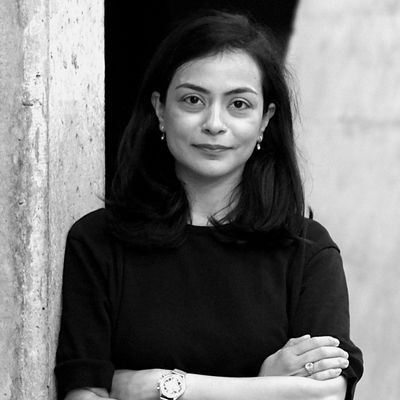
Veeranganakumari Solanki, a curator and writer based in Mumbai is interested in the way various forms and creative practices merge to create dialogues in public and private spaces with the convergence of images across disciplines. Her research and curatorial practice explore themes of memory, storytelling, time, and the way exhibitions can shape how we experience and understand art. Veerangana was the 2019 Brooks International Research Fellow at Tate Modern and a resident at the Delfina Foundation. She has previously worked as a programme director at Space Studio and The Gujral Foundation. She is a co-director of the SqwLab Foundation and a committee member of Mumbai’s NCPA Photography gallery.