
Wednesday - April 29, 2026

ART MUMBAI Writes: Art World
[Discover how NASA's Artemis II mission reshaped our understanding of perspective in art: both technical skill and personal artistic experiences.]
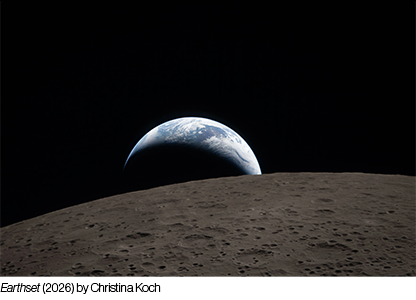
A photograph of the entire Earth is a strange thing. It is the biggest thing you will ever see look small. And you, along with your whole life, are inside it. When NASA's Artemis II crew completed their ten-day lunar flyby this April – the first crewed mission to the Moon's vicinity in over fifty years – they brought home images that do what only the most powerful art can: make you see the world differently.
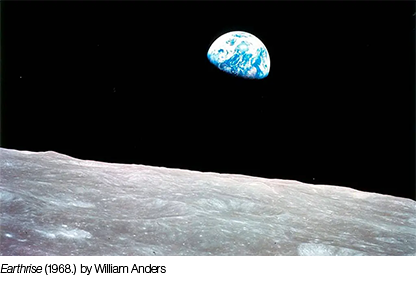
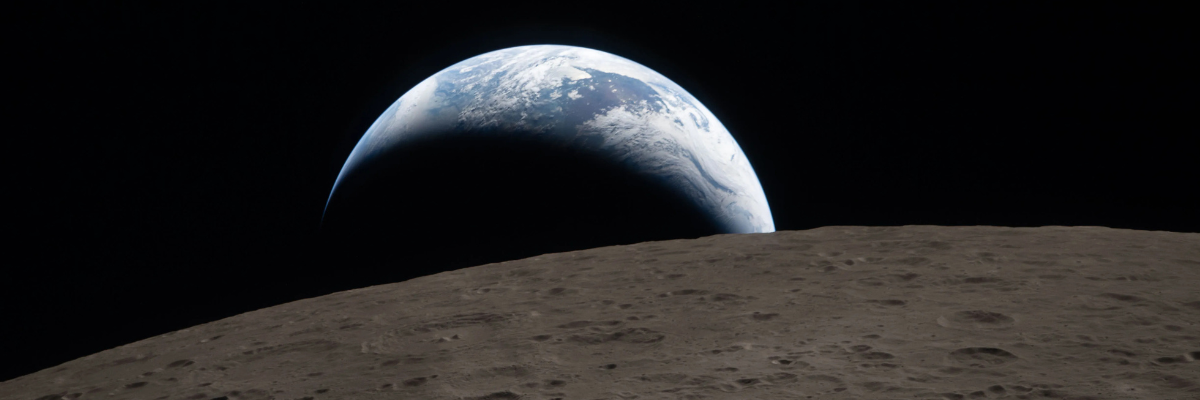
Among the most striking is Earthset – our planet slipping behind the lunar horizon, all hidden but for a pale crescent, luminous against the dark of space. It is a deliberate echo of Earthrise, the photograph taken by Apollo 8 astronaut William Anders in December 1968, which showed Earth rising above the lunar surface and is widely credited with catalysing the environmental movement. Nearly sixty years apart, both images achieve the same thing: they quietly dismantle the assumption that we are at the centre of everything. Earthset is not just a scientific photograph. It is a reminder that perspective – in the deepest sense – shapes everything.
In art, perspective works on two distinct levels, and understanding both helps explain why images like these resonate so deeply.
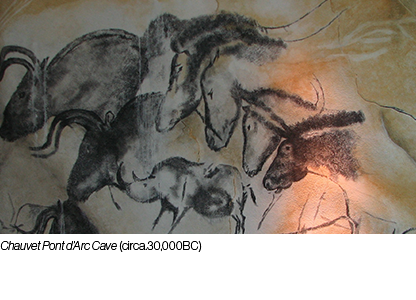
The first is technical. Perspective is the way we represent three-dimensional space on a two-dimensional surface – how a flat canvas is made to look as though it has depth. Its origins go back further than most people realise. At the Chauvet Cave in southern France, artists working around 31,000 years ago were already playing with spatial logic: horses drawn in overlapping layers, those further away placed behind those closer to the viewer. The desire to create depth, it turns out, is not a Renaissance discovery – it is a deeply human one.
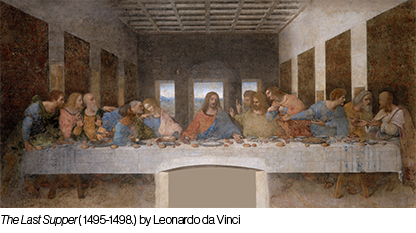
The ancient Greeks formalised this instinct, developing skenographia – a form of scene painting – to give theatrical backdrops convincing depth. Roman fresco painters used intuitive foreshortening to make their architectural illusions feel real. But it was in fifteenth-century Florence that perspective became a proper discipline. The architect Filippo Brunelleschi established the rules of linear perspective – the single vanishing point on the horizon line that would anchor Western painting for centuries. You can see his legacy clearly in the soaring arches of Masaccio's Trinity fresco and in the way every architectural detail of Leonardo da Vinci's The Last Supper draws your eye towards the central figure. And now, beyond the walls of galleries and museums, the same technique is applied on filmsets – where depth, painted by David Packard on the backdrops of false canvas corridors in Christopher Nolan’s ‘Tenet’ is, much like the film itself, an illusion.
Linear perspective gives artists a shared language for depicting space. But the second way perspective operates in art is more personal – and arguably more important.
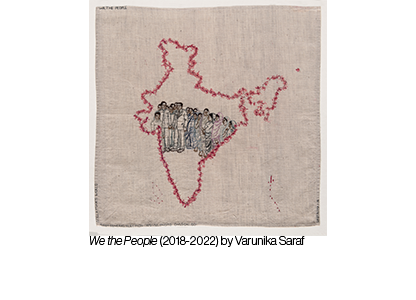
Every artwork, at its core, is a record of how the artist sees the world at that time, and how they ask us, as viewers, to acknowledge and change our perspectives accordingly. For example, Varunika Saraf, informed by art history, takes the perspective that elements of the past lead us to understand our current landscape. Saraf uses material, method and concept to reframe a history that we already know thereby tilting our heads in this new direction, as our perspectives change. In ‘We, the People’, khadi fabric, significant to the Indian freedom struggle, is Saraf’s canvas, embroidering it with historical events from India’s partition. This series of works becomes a way for both Saraf and the viewer to think about India’s future through the lens of the past, which Saraf believes will heal trauma. Showcasing historical events in historically significant material, only to leave us with a mirror to our present, Saraf offers a new lens through which to understand resistance and resilience.
The idea that perspective is shaped by experience and context, and consequently shapes future experience and context can also be seen on a broader scale. The Gutai Art Movement, which emerged in post-war Japan in the mid-1950s, was shaped by the collective trauma of a country rebuilding itself from ruin. Its artists – among them Jiro Yoshihara, Kazuo Shiraga, and Atsuko Tanaka – made work that was deliberately raw and physical: paint thrown, bodies used as tools, industrial materials brought into the gallery. Their perspective was one of honest urgency. They were not simply making art. They were making a case for the future.
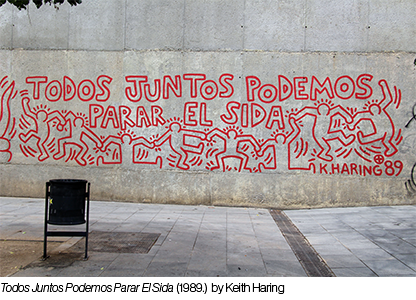
And art movements in response to crises can be seen all around the world. New York City erupted with art during the AIDS epidemic in the 1980s. As the disease moved through the city's creative communities, artists drew on their own personal experiences with loss, grief and anger in response to structural failure from public institutions. Keith Haring incorporated AIDS imagery into his murals, which forced the public to confront an issue systematically neglected. "Untitled" (Portrait of Ross in L.A.) by Félix González-Torres memorialised his late partner, Ross Laycock through individually wrapped candies, and Nan Goldin took photographs that explored the complexity and humanity of people diagnosed with HIV and AIDS. Here, art became a way of documenting and bearing witness when institutions didn’t, and a means and medium for pressuring societal change. Even today, this art stands as a testimony of what it means to love, mourn and fight back at the same time. While institutions shied away from addressing the epidemic, artists took matters into their own hands and changed public perceptions of AIDS by bringing open conversation into the mainstream.
Earthrise opened our eyes to the world from a new perspective nearly 70 years ago, and in doing so, ushered in a sense of urgency to protect the finite resources of our only home. In 2026, Earthset carries the same energy. In an age of rapid technological development and climate crisis, there is a huge degree of uncertainty about whether our planet can sustain humanity, and the questions being posed by Earthset feel imperative.
We have looked at the Moon our entire lives. The Artemis II crew looked back from it – and in doing so, allowed us to see ourselves from the outside. Perspective in art has never stood still. It began in firelit caves, moved through Greek theatres and Renaissance studios, and absorbed the upheaval of industrialisation, war, and social change. Now it will absorb this too. Every new vantage point we discover opens up new ways of seeing, new things to say, new reasons to make work.
Earthset is, in that sense, an invitation – the same invitation that art extends: look again, from somewhere new.
Image Courtesies:Earthrise (1968) and Earthset (2026), Courtesy of NASAWe the People (2018-2022) by Varunika Saraf, Courtesy of Chemould Prescott Road